
Your Business. Your Data. Your AI.
by CUBE TeamCUBE MCP CONNECTIVITY | THE NEXT EVOLUTION OF BUSINESS SOFTWARE
What if AI could do more than answer questions? What if it could help you run your entire business?
For decades, business software has helped companies organize information, manage operations, and improve productivity. But the fundamental relationship has remained the same: people operate the software. They navigate screens, search for information, prepare reports, analyze data, and coordinate activities across departments.
Artificial intelligence is about to change that relationship. At CUBE, we are taking an important step toward this future with the introduction of our Model Context Protocol (MCP) server, opening the door for compatible AI assistants to securely connect with business information and authorized tools.
And the possibilities are extraordinary.
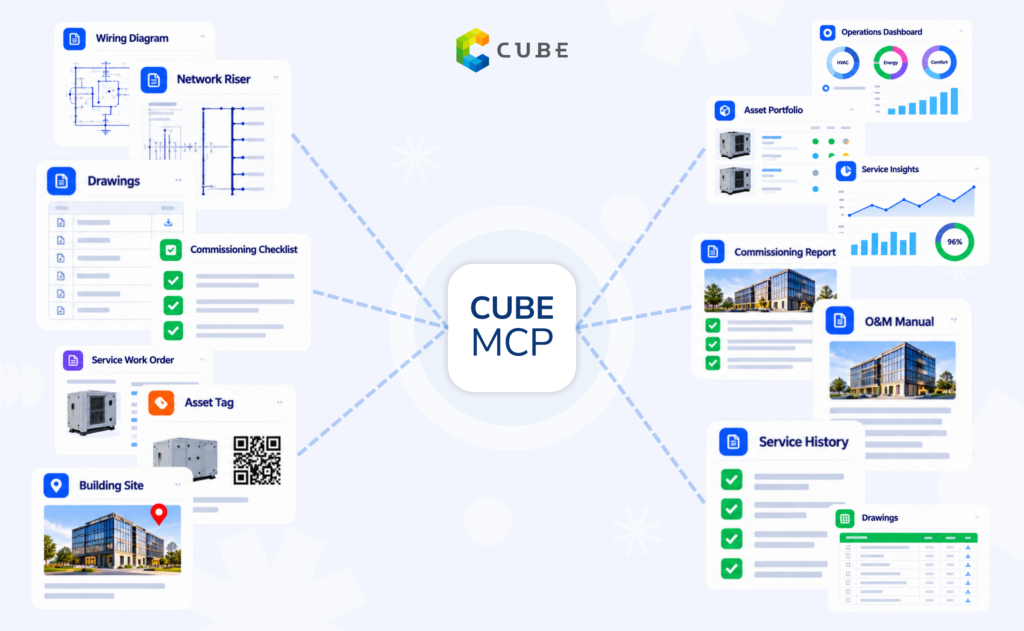
From managing your business to empowering AI to help run it
Think about how businesses operated before computers, the internet, and cloud software. Each technological advancement fundamentally changed how people worked. AI represents the next major transformation.
Imagine asking your business:
-
- Which of my projects are losing money, and why?
- Compare this estimate against similar projects we have completed.
- Which service contracts are underperforming?
- What maintenance activities are overdue?
- Show me our most profitable customers over the past 12 months.
- Review this engineering design and identify potential inconsistencies.
Now imagine getting answers based on your actual company information. And imagine going further: having AI assist with preparing estimates, creating documents, coordinating activities, and executing authorized workflows.
This is the future we are building toward.
Introducing CUBE MCP Connectivity
MCP is an open standard that allows compatible AI applications to communicate with external systems. In simple terms, it creates a bridge between artificial intelligence and the operational information already inside CUBE.
Your estimates. Your labor rates. Your project history. Your engineering standards. Your service operations. Your financial performance. This information represents years of company knowledge and experience. Now imagine making that knowledge accessible to AI so it can help your team work smarter, faster, and more effectively.
AI ASSISTANTS |
CONNECTION |
BUSINESS ENVIRONMENT |
| ChatGPT, Claude and compatible AI applications | CUBE MCP Server: authorized data and tools | Sales, Estimating, Engineering, Projects, Service and Financials |
Your estimates. Your labor rates. Your project history. Your engineering standards. Your service operations. Your financial performance. This information represents years of company knowledge and experience. Now imagine making that knowledge accessible to AI so it can help your team work smarter, faster, and more effectively.
Before AI. After AI. A completely different way of working.
The real value is not the technology itself. It is how that technology can transform everyday operations.
Sales & CRM
BEFORE AI |
WITH AI CONNECTIVITY |
| Salespeople search opportunities, customer records, historical estimates and reports to prepare proposals and follow-ups. | Ask AI to identify opportunities, analyze customer activity, compare past projects and prepare follow-up communications. |
Estimating
BEFORE AI |
WITH AI CONNECTIVITY |
| Estimators manually review labor rates, equipment costs, historical estimates and pricing assumptions. | AI helps compare similar projects, identify unusual costs, review labor assumptions and prepare draft estimates. |
Engineering
BEFORE AI |
WITH AI CONNECTIVITY |
| Engineers review drawings, point lists, equipment libraries and engineering standards across multiple tools. | AI assists with reviewing requirements, identifying missing points, checking standards and preparing engineering deliverables. |
Project Management
BEFORE AI |
WITH AI CONNECTIVITY |
| Project managers review budgets, labor, purchase orders, schedules and profitability to identify problems. | Ask AI which projects are at risk, what is driving cost overruns and where management attention is needed. |
Service Management
BEFORE AI |
WITH AI CONNECTIVITY |
| Service managers coordinate technicians, maintenance schedules, contracts, work orders and customer assets. | AI helps identify overdue maintenance, analyze service performance and prepare scheduling recommendations. |
Executive Management
BEFORE AI |
WITH AI CONNECTIVITY |
| Executives request reports, review spreadsheets and gather information from multiple departments. | Ask AI how the business is performing, where profitability is changing and which issues require attention. |
These are illustrative future workflows. Availability depends on the AI tools and integrations implemented.
The bigger opportunity: Your own AI workforce
Imagine a future where every department in your company has an AI assistant that understands its operations, processes and priorities.
AI ASSISTANT |
POTENTIAL SUPPORT |
| AI Sales Assistant | Opportunity analysis, customer insights, proposals and follow-ups |
| AI Estimator | Historical comparisons, cost analysis and estimating support |
| AI Engineering Assistant | Design validation, standards and documentation |
| AI Project Coordinator | Budgets, schedules, labor performance and project risks |
| AI Service Coordinator | Work orders, maintenance, contracts and scheduling |
| AI Business Analyst | Financial visibility, operational performance and business insights |
These assistants could work with the same underlying business environment, supporting employees with relevant information and, where authorized, helping complete tasks. The potential goes beyond saving time. It creates opportunities to standardize processes, reduce repetitive work, improve decision-making and make sophisticated capabilities available throughout the organization.
This is not about replacing the people who make your business successful. It is about giving them capabilities that previously required significantly more time, effort and resources.
Why this is different from traditional AI
Most people have already experienced AI. It can write emails, summarize documents, answer questions and generate ideas. But there is a significant limitation: generic AI does not automatically know your business.
It does not know your labor rates, equipment costs, estimating standards, customer history, service contracts or project profitability. When AI can securely access the right information through CUBE, the conversation changes.
TRADITIONAL AI |
AI CONNECTED TO CUBE |
| How can a contractor improve project profitability? General recommendations based on broad knowledge. | Which of our projects are losing money, and why? Business-specific insights using authorized company data. |
Instead of asking AI how a business should operate, you can begin asking AI how your business is actually performing. And as additional tools become available, AI can move beyond analyzing information to assisting with real operational workflows.
From software features to business capabilities
Traditional software is built around predefined functionality. AI connectivity introduces another possibility: businesses can begin building intelligent workflows around their own operational requirements.
TRADITIONAL SOFTWARE |
AI-CONNECTED SOFTWARE |
| Navigate screens to find information | Ask questions in natural language |
| Manually compile reports | Generate analyses from connected data |
| Search historical records | Compare information across projects |
| Follow repetitive procedures | Automate supported, authorized workflows |
| Depend on predefined reporting | Explore new questions dynamically |
| Adapt processes to software limitations | Create AI-assisted workflows around business needs |
The question is no longer just, “What features does this software have?” It becomes: “What can my business accomplish with the information and capabilities already available in my platform?”
Built around your business. With security and control.
Connecting AI to business operations requires security, appropriate permissions and operational safeguards. AI should only access the information and tools it is authorized to use. Not every activity should be automated. Important financial, operational and customer-facing decisions may require human approval.
The CUBE MCP initiative is intended to support a controlled approach to AI connectivity, allowing businesses to explore new capabilities while maintaining appropriate oversight. The exact information accessible and actions available depend on the tools, integrations and permissions configured.
The goal is not automation without control. It is intelligence and automation that work for your business.
This is only the beginning
We are entering a period in which the relationship between people, software and business information may change dramatically. Just as computers, the internet and cloud platforms transformed business operations, AI has the potential to redefine how work gets done.
The companies that benefit most will not necessarily be the ones with the most software. They will be the companies that make the best use of their information, processes and people.
At CUBE, we believe the future of business software is not simply about adding more screens, features or reports. It is about making business information more accessible, operations more intelligent and employees more productive. Our MCP server is an important step toward that future.
Your Business. Your Data. Your AI.
Imagine what your company could accomplish if every department had an intelligent assistant that understood its operations. Imagine the time your employees could recover, the problems you could identify earlier, and the opportunities you could discover.
The future is not just about using software to manage your business. It is about empowering AI to help you run it.
And at CUBE, we are building toward that future.