
Practical Technology: Small Changes That Can Make a Big Impact on Your Business
by CUBE TeamTechnology doesn’t always have to create a major transformation overnight to make a meaningful difference. Sometimes, the biggest improvements come from automating the smallest, most repetitive tasks.
Think about Excel macros.
A simple macro might save five minutes on a task. Not much by itself. But multiply those five minutes across hundreds of activities, multiple employees, and different departments, and suddenly the impact becomes significant.
That’s exactly the opportunity we’re seeing today with AI assistants, bots, and the tools available through CUBE.
I want to share a few practical examples of how we’re using these technologies ourselves to improve productivity in the services we deliver, and how similar tools can help your team work more efficiently.
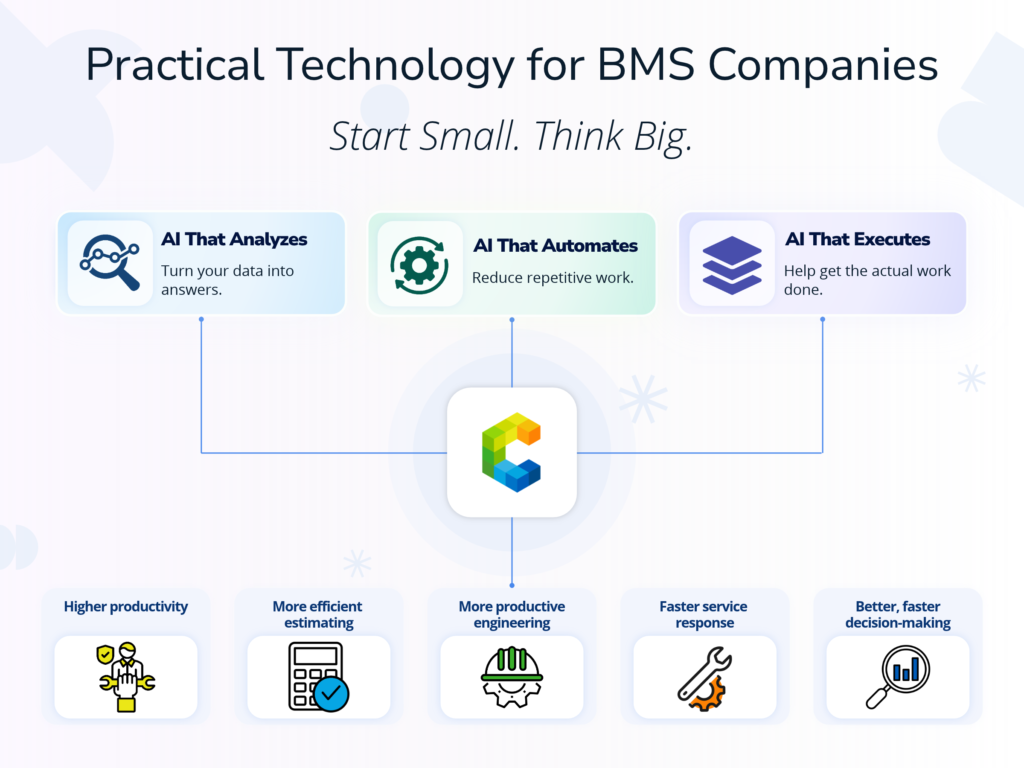
Three Types of AI Bots and How They Work
At CUBE, we’ve organized these capabilities into three main categories: AI that analyzes, AI that automates, and AI that executes.
Each addresses a different type of activity, but together they can have a tremendous impact on daily operations.
1. AI That Analyzes: Turn Your Data Into Answers
How much time does your team spend searching for information, exporting data into Excel, or preparing reports?
With CUBE AI Tools and our MCP server, AI assistants can connect to your authorized CUBE data and help answer business questions using everyday language.
For example:
- “Which sales opportunities need immediate attention?”
- “How are our estimates performing?”
- “Which projects have upcoming bid dates?”
- “What does our current sales pipeline look like?”
Instead of manually navigating multiple screens or assembling spreadsheets, you can ask a question and retrieve the information you need.
The benefit: Less time gathering information and more time making decisions.
2. AI That Automates: Reduce Repetitive Work
Now imagine tools that don’t wait for someone to ask a question. They can process information, recognize patterns, and initiate activities based on established rules.
Some practical examples include:
- Email processing: Read incoming emails, identify action items, and help route them to the appropriate person.
- Service reports: Review completed service reports, identify follow-up requirements, and help assign activities.
- Recurring reports: Prepare operational summaries, financial reports, and performance updates automatically.
- Workflow monitoring: Identify activities that require attention, such as completed work orders awaiting invoicing.
These are the types of activities that consume time throughout the day without necessarily adding value to the services we deliver.
The benefit: Fewer manual steps, more consistent processes, and less administrative work.
3. AI That Executes: Help Get the Actual Work Done
This is where things become particularly interesting.
Instead of simply retrieving information or triggering workflows, these assistants can help perform actual tasks.
We’re already using AI-assisted processes within our professional services operations to help with activities such as:
- Mechanical takeoffs: Read plans and identify equipment and control requirements.
- System library matching: Compare equipment requirements against existing CUBE system libraries.
- Engineering schedules: Prepare equipment schedules and I/O configurations.
- Data preparation: Organize and prepare information that would otherwise require extensive manual entry.
For authorized execution workflows, assistants can also help update schedule values or I/O configurations, subject to the appropriate permissions, validation, and approval.
The objective isn’t to eliminate engineering judgment. It’s to reduce the repetitive work so experienced people can focus on reviewing, validating, and making decisions.
The benefit: More work completed with the same resources, without sacrificing professional oversight.
The Real Opportunity: The Ripple Effect
Here’s what I find most interesting about all of this.
Individually, none of these improvements may seem revolutionary.
Saving five minutes preparing a report. Reducing an hour of engineering data entry. Automatically routing a service request. Finding an estimate without searching through multiple records.
But consider what happens when those improvements begin multiplying across your organization.
Estimating becomes more efficient. Engineering teams spend less time on repetitive activities. Service departments respond faster. Managers get information without waiting for reports.
Small improvements at the task level begin creating significant improvements at the company level.
That’s the ripple effect.
And unlike traditional technology projects that require major operational changes, many of these improvements can be introduced gradually, one activity at a time.
We’re Using These Tools Ourselves
At CUBE, we’re not just exploring what this technology might accomplish someday.
We’re already applying these approaches in our own operations, particularly within our professional services team, where many of the activities we perform are similar to the work our customers do every day.
Through CUBE AI Tools, our MCP server, and specialized assistants, we’re connecting AI capabilities with the information and workflows that already exist inside CUBE.
Some capabilities are available directly through authorized CUBE connections today. Others are used in our internal workflows or require additional automation and execution permissions.
The goal is simple: make these technologies practical, accessible, and useful in everyday work.
Start Small. Think Big.
You don’t need to automate your entire company to see results.
Start with one repetitive activity. One report. One engineering process. One administrative task.
Measure the time saved, improve the process, and move to the next opportunity.
Over time, those small improvements begin to add up.
The real value of this technology isn’t necessarily in doing something extraordinary once. It’s in making the ordinary things we do every day significantly more efficient.
And that’s where I believe the biggest opportunity lies.
Want to see these tools in action?
If you’re already using CUBE, we’d be happy to show you practical examples of how CUBE AI Tools can work with your data and help improve your daily workflows.