
The Human Pipeline Is Breaking. Automation Isn’t the Problem. It’s the Solution.
I heard a statistic at a trades meeting this week that stopped me cold.
For every five people retiring from the skilled trades, only two are replacing them.
Then someone in the room shared another number.
There are roughly 980 electrical license holders in the area. Only about 50 are under the age of 30.
That is not a temporary labor shortage.
That is a demographic cliff.
This isn’t a hiring problem.
It’s a math problem.
We’ve Been Looking at the Wrong Side of the Equation
Most of the conversation today revolves around one fear:
“AI is going to take jobs.”
In many office environments, that’s not entirely wrong. Administrative work, repetitive documentation, data entry, scheduling, reporting, and many engineering support tasks are already being automated or dramatically accelerated.
Large organizations know this.
They aren’t simply eliminating costs.
They’re reallocating them.
Because while software can replace repetitive office work, it cannot replace a licensed electrician standing in front of a live electrical panel, installing controls, troubleshooting a network, commissioning a building, or solving problems in the field.
The bottleneck is shifting.
The Trades Are Becoming the Scarce Resource
For decades, the advice was simple:
Go to college.
Get an office job.
Work behind a computer.
Now the market is changing.
The scarcity isn’t in people who can answer emails.
It’s in people who can build, install, commission, troubleshoot, and maintain the infrastructure our buildings depend on.
Electricians.
HVAC technicians.
Building automation specialists.
Control technicians.
Commissioning professionals.
These careers are becoming some of the most valuable professions in the economy because demand continues to grow while the supply of experienced workers continues to shrink.
Technology Isn’t Competing With the Trades
This is where I think many people misunderstand what is happening.
Technology is not replacing skilled trades.
Technology is becoming the force multiplier that allows fewer people to accomplish more.
When documentation is generated automatically…
When estimates take hours instead of days…
When engineering drawings are validated before they reach the field…
When commissioning catches problems before technicians arrive…
When service history is available instantly…
The technician spends less time fighting paperwork and more time solving problems.
That doesn’t replace expertise.
It amplifies it.
The Companies That Win Will Augment Their People
The future won’t belong to companies with the biggest workforce.
It will belong to companies that make every technician more productive.
Every unnecessary hour spent creating documents manually is an hour that could have been spent installing, servicing, commissioning, or supporting another customer.
As experienced people retire, companies won’t have the luxury of replacing every position one-for-one.
They’ll need technology to close the gap.
Not because they want to.
Because they’ll have to.
This Is Bigger Than Building Automation
Building automation happens to be the industry I work in, but this trend extends across every skilled trade.
Electrical.
Mechanical.
Plumbing.
Fire protection.
Industrial controls.
Manufacturing.
Infrastructure.
The shortage is real, and it isn’t going away.
The Question Every Leader Should Be Asking
The real question isn’t whether AI or automation will change your business.
It already is.
The question is whether you’re using it to strengthen the people you have.
Because the companies that embrace automation to eliminate repetitive work will free their teams to focus on the work that only skilled professionals can perform.
And those professionals are becoming increasingly valuable every year.
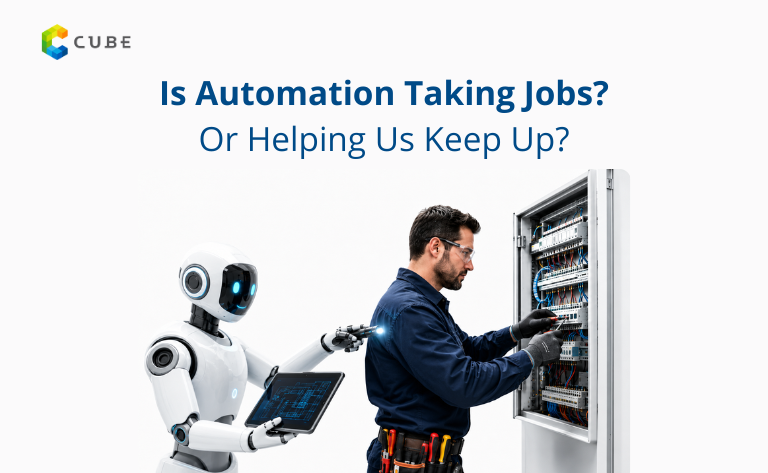
The electrician standing in front of the panel…
The controls technician commissioning the building…
The service technician diagnosing a problem…
They may soon become the most valuable people in the company.
The human pipeline is shrinking.
Technology isn’t replacing it.
Technology is what gives us a chance to keep up.
BMS owners, contractors, and industry leaders—are you preparing your business for this shift, or are you hoping it doesn’t arrive?
I’d love to hear your thoughts.