
Why the Companies That Win Tomorrow Are Building Differently Today
There is a pattern I have watched repeat itself across the BMS industry for the last twenty years.
A company finds a tool that works. They build their entire workflow around it. They train their people on it. They get good at it. And then the industry moves and the tool does not.
Now they have a choice. Rebuild everything and lose the ground they gained. Or stay with what they have and fall further behind.
Most companies choose to stay. Not because they are not smart. Because rebuilding is expensive, disruptive, and risky. So they patch. They add a workaround. They buy another tool to fill the gap. And then another.
Over time they are managing five tools that do not talk to each other, training people on workflows that make no logical sense, and spending more energy on coordination than on actual engineering.
This is not a technology problem. It is an architecture problem.
The Difference Between Buying Technology and Being Ready for It
Most companies think about technology adoption as a purchasing decision. Which tool is the best right now? Which one solves the most problems today?
That is the wrong question.
The right question is: when the next wave of technology arrives, how fast can my business absorb it without rebuilding everything from scratch?
The companies that are winning right now are not the ones with the best software. They are the ones who built their operations on foundations that do not fight new technology when it arrives. They adopt faster. They integrate faster. They train faster. And because of that they widen the gap between themselves and everyone else with every new wave.
Technology readiness is not about what you have today. It is about how fast you can absorb what is coming tomorrow.
What Is Coming in the BMS Industry
The BMS industry is at a specific inflection point right now. Several things are happening at the same time and they are compounding.
The talent problem is not going away.
There are not enough trained BMS engineers to meet demand. Companies that cannot automate the repetitive parts of engineering will hit a wall. They cannot hire their way out of it. The talent does not exist at the scale they need.
Projects are getting more complex, not less.
Global infrastructure. Data centers across multiple countries. Systems that have to be commissioned and maintained by technicians who may not speak the same language as the engineer who designed them. The documentation requirements alone are beyond what manual processes can reliably deliver.
The building is becoming a data source.
Live controllers. Real-time connectivity. The ability to read what is actually programmed in a building and bring it back into the engineering workflow automatically. This is not a future concept. It is happening now. The companies that can work with live building data will deliver a completely different level of service than those who cannot.
AI is changing the front end of every process.
Estimates that used to take days are being generated in minutes. Drawings that required senior engineers are being produced by junior staff with AI assistance. Commissioning documentation that was manually logged point by point is being updated automatically as the technician works. These are not incremental improvements. They are structural changes to how BMS work gets done.
The companies that absorb these changes fastest will not just be more productive. They will be operating in a fundamentally different category from those that do not.
What Technology Readiness Actually Looks Like
A technology-ready company does not look dramatically different from the outside. They use similar tools. They employ similar people. They bid similar projects.
The difference is underneath.
Their processes are built on a foundation that is designed to absorb new capabilities without breaking what already works. When a new integration becomes available, they connect it. When a new automation tool emerges, they plug it in. When the industry shifts, they shift with it in weeks instead of years.
This requires a specific kind of discipline. It means choosing platforms over point solutions. It means building on open infrastructure rather than closed tools. It means making decisions today that preserve your ability to move fast tomorrow, even when the closed tool looks better on a feature comparison today.
The most dangerous thing a BMS company can do right now is build their entire operation on a platform that cannot grow with them. Not because the platform is bad today. Because the industry will not look the same in three years and a closed tool will not be able to follow it.
The Decision We Made at CUBE
Everything I have described above is why we made a decision at CUBE that I believe is one of the most important we have ever made.
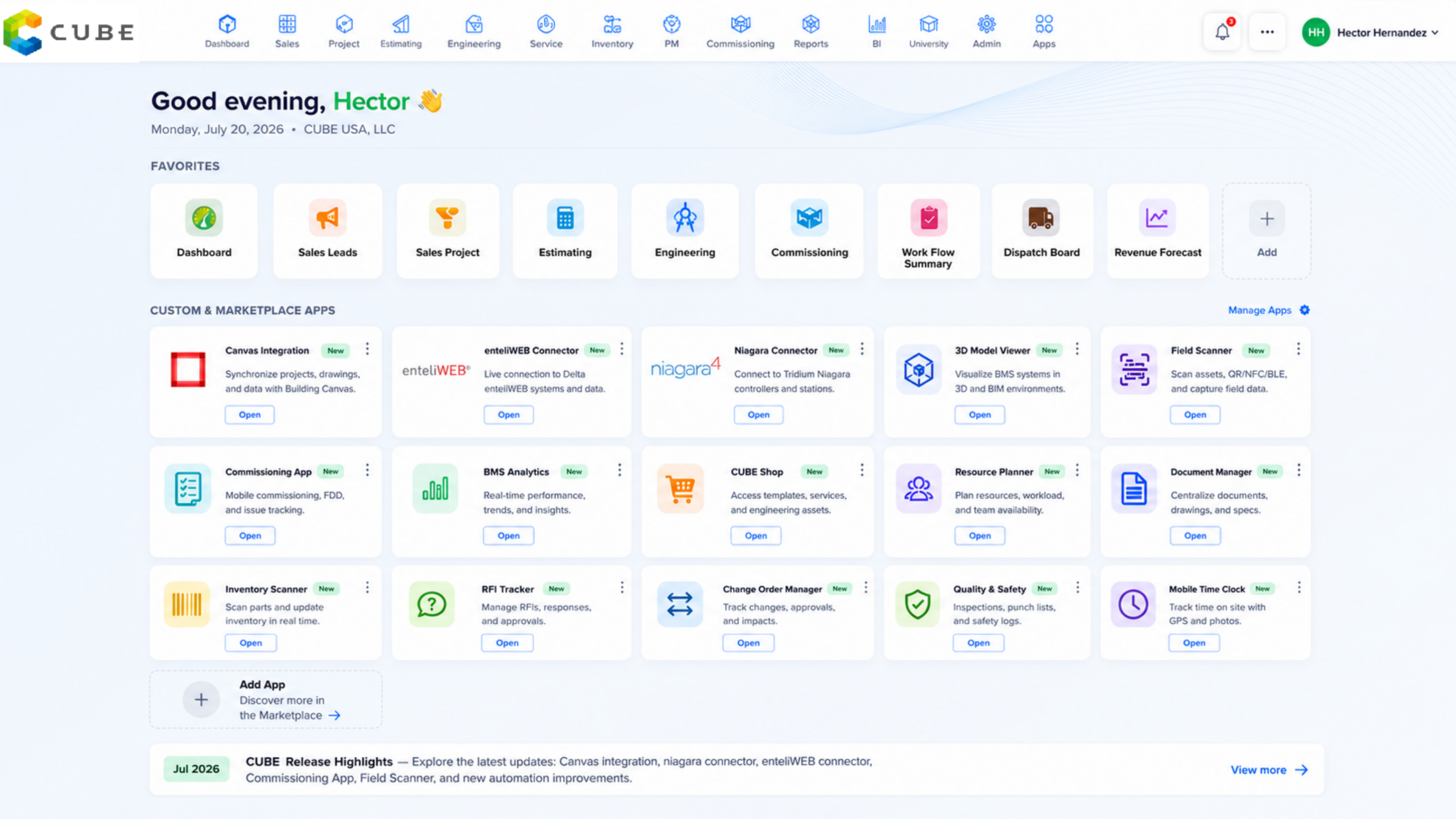
We shifted our architecture from a closed platform to an open one. Docker-based infrastructure. Full API access. The ability for developers, manufacturers, and technology partners to build directly on top of CUBE and distribute through it.
We did not do this because we ran out of things to build. We did it because we recognized that the wave of technology coming to this industry is bigger than any single team can build fast enough to cover.
The BMS contractor who builds on an open platform does not have to wait for us to build the next integration. The manufacturer who wants to connect to the engineering workflow does not need a custom project. The developer who sees a gap the industry needs filled can build it and bring it to every contractor already on the platform.
This is not a product announcement. It is a commitment to building the kind of infrastructure that moves with the industry instead of chasing it.
CUBE stops being a product you buy and becomes the platform you build your business on. Your tools, your integrations, your way.
The companies that figure this out first will not just work differently. They will compete in a category their competitors cannot reach.